
Payer synergy assumptions in healthcare M&A — and what they are actually worth
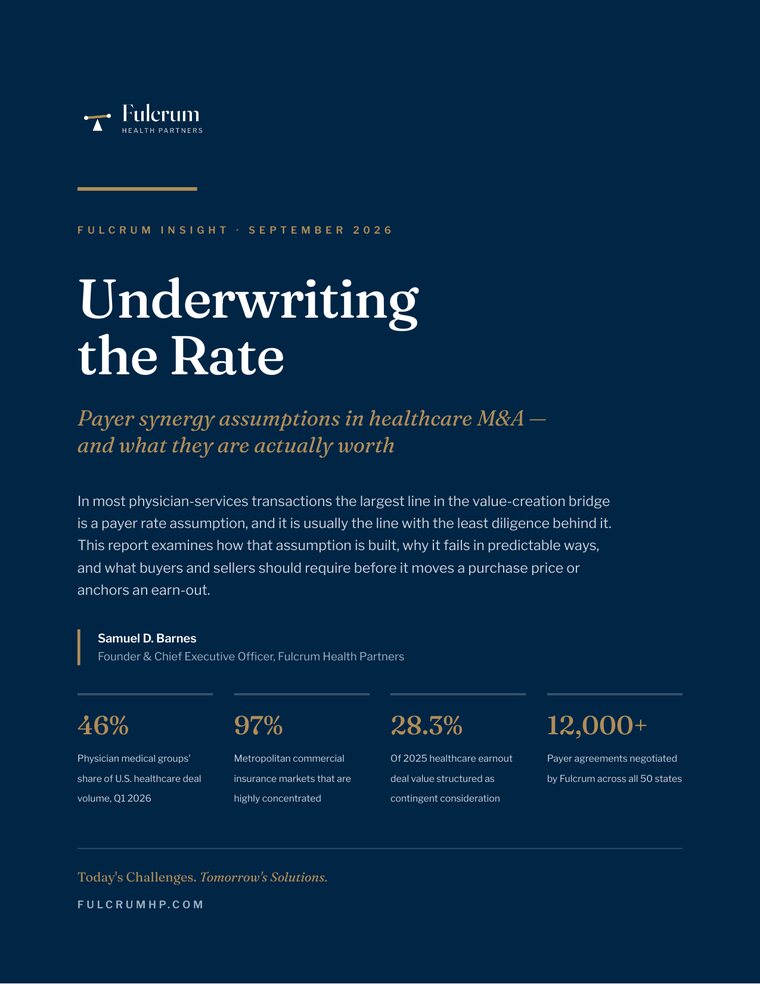
In most physician-services transactions the largest line in the value-creation bridge is a payer rate assumption, and it is usually the line with the least diligence behind it. This report examines how that assumption is built, why it fails in predictable ways, and what buyers and sellers should require before it moves a purchase price or anchors an earn-out.
Tell us who you are and your download starts right away.
If the download did not start, use the button below. The link works for 30 minutes. Questions on a live deal: sales@fulcrumhp.com.
Download the Report See how we work on transactions →Sources, left to right: LevinPro HC / Irving Levin Associates transaction data, as reported by FOCUS Investment Banking (Q1 2026) · American Medical Association, Competition in Health Insurance, 2025 edition (2024 data) · Charles River Associates, Earnouts in M&A, March 2026 (FY2025 private-target transactions) · Fulcrum Health Partners.
A quality of earnings review validates the history that produced today’s rate. Nobody validates tomorrow’s. The report works through where that gap comes from, what it is worth at current multiples, and how to close it on either side of the table.
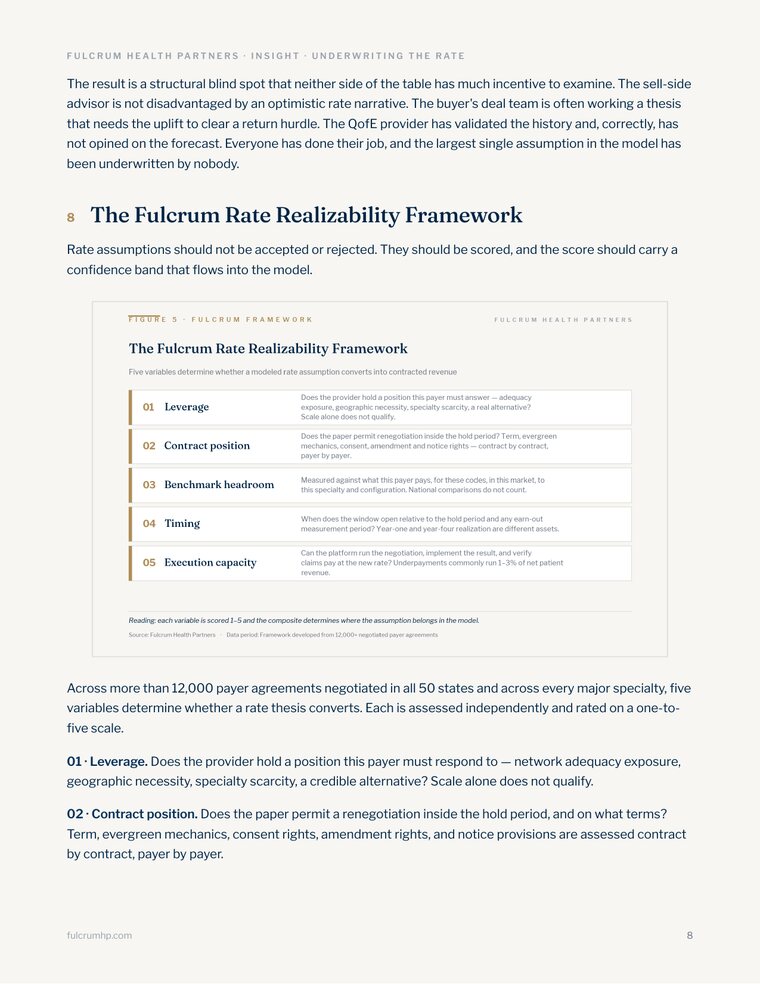
Rate assumptions should not be accepted or rejected. They should be scored, and the score should carry a confidence band that flows into the model. Five variables determine whether a rate thesis converts.
Underwriting a physician-services platform or add-on where a rate assumption sits in the value-creation bridge.
Building or defending a rate-synergy narrative that has to survive buy-side diligence.
Facing an earn-out tied to a payer rate improvement someone else modeled.
Evaluating an acquisition where the target’s commercial book is the asset.
Fulcrum Health Partners has negotiated more than 12,000 payer agreements across all 50 states and every major specialty — which is why we can tell a buyer or a seller what a specific payer will actually do, in a specific market, for a specific specialty, inside a specific hold period.
This Insight is provided for informational purposes and does not constitute legal, financial, tax, or actuarial advice.